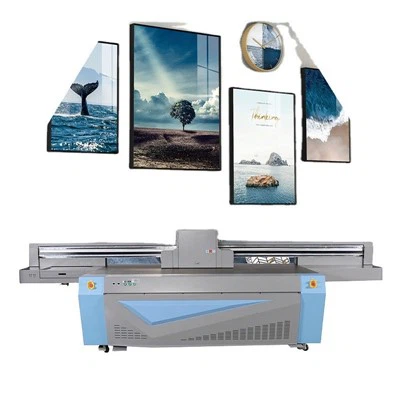

Those who make advertisements know that UV printers printing patterns requiring surface treatment of the raw materials, that is, spraying a layer of surface treatment agent (coating) on the surface of the raw materials. The treatment agent used on the surface of UV flatbed printing materials is called UV coating, which directly affects the adhesion of our printed patterns.
UV coating liquid is refined from special modified resins and special auxiliary materials, or refined from special polymer materials. It is suitable for glass, ceramic tiles, metals, melamine boards, nylon PET,PVC,PC,ABS. The main function of materials such as stone is to enhance the adhesion of UV printed patterns. It has properties such as fast drying speed, low odor, strong water resistance and waterproofing. Coatings are designed for materials and inks, one material for one coating, while also considering the performance of UV ink.
Types of UV coatings
There are currently 6 types of commonly used UV printer coatings on the market:
01 Glass coating
Suitable for special treated glass materials such as organic glass, tempered glass, glazed ceramic tiles, crystals, etc. There are two types: quick drying coating and baking. The former can print patterns after wiping and letting it stand for 10 minutes, while the latter needs to be baked in an oven before printing patterns.


02 PC coating
Some PC materials with harder materials usually have poor adhesion; Some PC materials can be printed directly without the need for coating; Generally, when printing imported acrylic boards, it is necessary to wipe the PC coating.


03 Metal coating
Suitable for materials such as aluminum, copper plate, tin plate, aluminum alloy, etc.. There are two types: transparent and white. It should be used on the finished product and cannot be used before stamping or injection molding, otherwise the effect will be greatly reduced.


04 Leather coating
Suitable for genuine leather, leather, PVC leather, PU leather, etc., can be sprayed on the surface of leather material and allowed to air dry naturally.


05 ABS coating
Suitable for wooden boards, PVC, ABS, Gypsum, thickened kraft paper, acrylic, PS, PE etc. After wiping the coating on the surface of materials, it can be naturally dried and printed.


06 Silicone coating
Suitable for silicone and rubber materials. Poor surface activity requires flame treatment, otherwise the adhesion is insufficient. Flame treatment usually relies on experience, and the surface should not be sprayed too thick, otherwise it is not easy to dry.


Usage of UV coating
No.1 Allocation
The required mixing agent for coating has a fixed proportion and mixing techniques, which should be carried out according to the instructions.
No.2 Cleaning
Before operation, it is necessary to thoroughly remove oil stains, water stains, and dust from the areas that require coating treatment, and keep them dry and clean.
No.3 Compatibility
Once it is discovered that the coating has undergone chemical reactions such as dissolution and foaming with UV ink, a more compatible coating needs to be replaced.
No.4 Protection
The irritating odor of the coating is generally strong, and masks and disposable gloves can be worn during operation.
No.5 Adaptation
The types of coatings corresponding to different materials are also different. Do not use one coating to adapt to other materials.
No.6 Spraying
Avoid pressing the nozzle too deeply during the spraying layer operation to prevent a large amount of liquid from spraying out and causing uneven spraying.
No.7 drying tool
For drying air ducts (hair dryers), it is best to choose low wind speed and low noise, and household ovens can also be used as drying equipment.
No.8 Drying time
It takes about 4-8 minutes for the coating to dry in a natural environment (the time may vary slightly depending on the material). Using a hot air duct, the coating can dry in about 1 minute. The hot air cylinder must be operated 30cm away from the surface of the coated medium to avoid the coating being unevenly blown by strong winds when in liquid form, which may affect the effectiveness of use.
No.9 Avoid contact
Do not touch the coating until it is completely dry, and try to minimize contact with the dried coating surface to avoid affecting the printing effect.
Precautions for using UV coating
1. UV coating materials should be of reliable quality and tested repeatedly by the original equipment manufacturer;
2. Different materials should use different UV coatings, and never mix them together;
3. The weather is humid and the temperature is low. After the UV coating is sprayed, it needs to be left for an additional period of time to dry thoroughly before the effect will be better;
4. The coating preparation ratio is not fixed, and when the weather temperature and humidity change, the original ratio should also be adjusted appropriately. UV coating is a temporary addition of a small amount of curing agent according to the required amount before use. If a large amount of coating is added at once, the coating will easily dry, causing unnecessary waste;
5. UV coating belongs to flammable materials, please place it away from fire sources;
6. If the UV coating accidentally enters the eyes, please rinse it with clean water in a timely manner and seek medical attention nearby;
7. Spray the coating evenly, not too thick or too thin;
Precautions for storing UV coatings
1. Please place the UV coating solution in a cool and backlit place. After each use, be sure to seal it as soon as possible before storing it;
2. Before printing the product, please clean the surface of the material with alcohol and a dust-free cloth, and then evenly wipe the coating on the material with a dust-free cloth, especially the edges around the material must be wiped well;
3. Do not lift the lid of the coating liquid container for a long time, and do not let the coating come into contact with air for a long time to prevent the components of the coating liquid from evaporating. Before using it every day, it is recommended to pour some into a hand spray bottle and plastic bottle, and pour in as much as needed;
4. Before mass production printing, it is recommended to make a small sample in advance to test the adhesion (color fastness), and then print in bulk after passing the test. Due to some special materials and coating usage, there may be differences.