


Digital printing technology has fundamentally changed how products like tiles, panels, and glass are made - shifting from large-scale, standardized mass production toward small-batch, highly customizable print-on-demand (POD) manufacturing. Here's a look at how this transformation unfolded across three defining phases.
Phase 1: The Exploration Years (1990s–2000s)
It all started with a breakthrough from Spain.
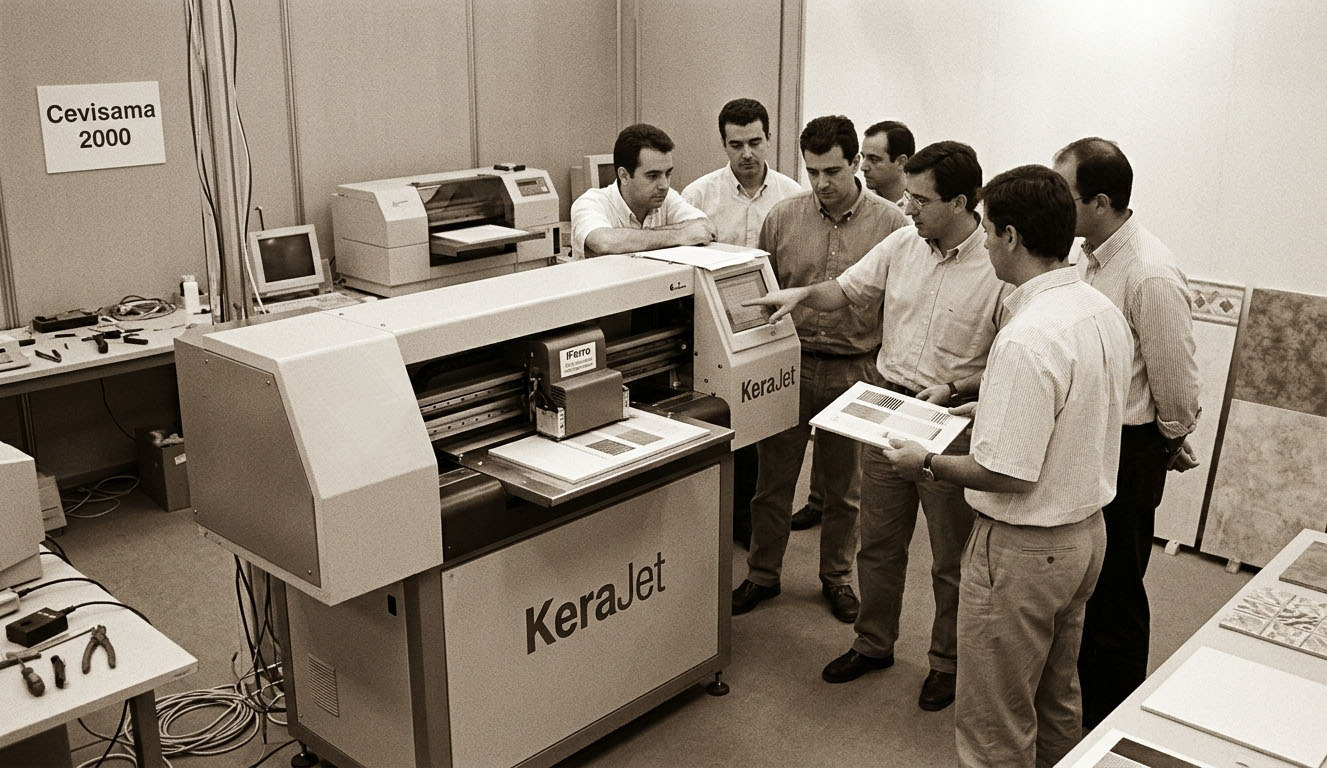
In 1998, the Tomás brothers founded KeraJet, a company dedicated to developing digital inkjet printing technology for ceramic tiles. At the 2000 Cevisama trade show in Spain, KeraJet unveiled the K350 - the world's first industrial ceramic inkjet printer. Built around Xaar printheads and Ferro inks, it was the first machine to bring digital inkjet printing to ceramic tile production at an industrial scale, and it's widely recognized as the true starting point of digital printing in the building materials industry.
In 2004, Italian company Durst launched its Gamma series of ceramic inkjet printers, taking the technology a step further toward standardized, large-scale production. With deep roots in industrial inkjet technology, Durst quickly became a major leader in the space.
That said, digital printing was still very much in its early days during this period. Equipment costs were high, print precision was limited, and the inks and coatings needed for durable building material surfaces weren't fully developed. Print quality couldn't yet match traditional roller printing. As a result, digital printers were mostly used for short-run sampling of high-end custom tiles and decorative panels. Most building material manufacturers saw them as a useful prototyping tool - not as something that would reshape the entire industry.
Phase 2: Rapid Growth and Market Expansion (2010s–2020)
The 2010s marked a turning point. Digital printing in building materials shifted from an interesting technology into a mainstream production method.
On the technology side, 1,024-level grayscale piezoelectric printheads became widely available, pushing print resolution from the early standard of 360 dpi to over 1,200 dpi. Specialized inks and coatings for different materials - ceramics, glass, wood panels - matured significantly, meeting industrial standards for adhesion, weather resistance, and durability. Equipment costs dropped 60–70% compared to the early days, making the technology accessible to far more manufacturers.
Around 2011, China developed its first domestically produced ceramic inkjet printer, breaking the international monopoly that had slowed domestic adoption and accelerating the spread of digital printing across China's building materials industry.
In terms of application, digital printing expanded well beyond tiles to cover glass, wood panels, decorative paper, metal sheets, and more. Major building materials companies started installing digital printing lines, and by around 2015, digital printing equipment penetration in the global ceramics industry had passed 50%, with China exceeding 40%.
At the same time, the explosive growth of the whole-home customization market in China gave POD manufacturing real commercial traction. Small and mid-sized building material companies and interior design firms could now use digital printing service providers to produce customized products in small quantities - completely bypassing the minimum order requirements that had long been a barrier with traditional manufacturing.
By 2020, the global building materials digital printing market was estimated at around $800 million to $1 billion. Digital printing penetration in the ceramics industry surpassed 70% globally and 80% in China. POD manufacturing had grown from a niche concept into a recognized and significant part of how building materials are made and sold.

Phase 3: A Mature Ecosystem (2020–Present)
Since 2020, the building materials digital print-on-demand model has reached full maturity.
Three forces are driving growth in this phase: the global push for sustainability, rapid advances in AI and digital technology, and the continued rise of integrated whole-home customization.
In terms of scope, POD has expanded beyond tiles and decorative panels to include full-home surface finishes and functional building materials. Leading building materials companies have integrated POD into their standard operations and are repositioning themselves - not just as product manufacturers, but as providers of end-to-end space customization solutions.
On the sustainability front, POD's advantages in reducing raw material waste, cutting carbon emissions, and lowering pollutant output have earned it broad recognition across global markets.
Technologically, AI-driven design generation, block chain-based supply chain tracking, and eco-friendly materials are all converging with building materials POD workflows - enabling intelligent management of the entire production cycle, from design and scheduling to quality control and logistics.
By 2024, over 50% of the world's leading building materials companies had established some form of digital on-demand production system. POD has completed its journey from "a new type of printing technology" to a core solution for digital transformation in building materials manufacturing.


